
Most of the AI people talk about talks back. The more useful kind often doesn't. It sits inside a chip design, a data center scheduler, a pair of headphones or a game studio's test lab, doing one narrow job well, and nobody notices it at all. One of the best examples went on general release this summer: on 9 July Google made AlphaEvolve, a system from Google DeepMind that writes and improves code, available to everyone on Google Cloud.

AlphaEvolve is not a chatbot. DeepMind calls it an evolutionary coding agent. Two Gemini models do the writing, the fast Gemini Flash to come up with lots of ideas and the more powerful Gemini Pro to go deeper, and between them they propose changes to a program. Automated evaluators then run every proposal and score it against a goal, a faster result or a smaller circuit. The best-scoring programs are kept and used to prompt the next round, and the loop goes again. It is evolution, with code in place of DNA and a test suite in place of the environment.
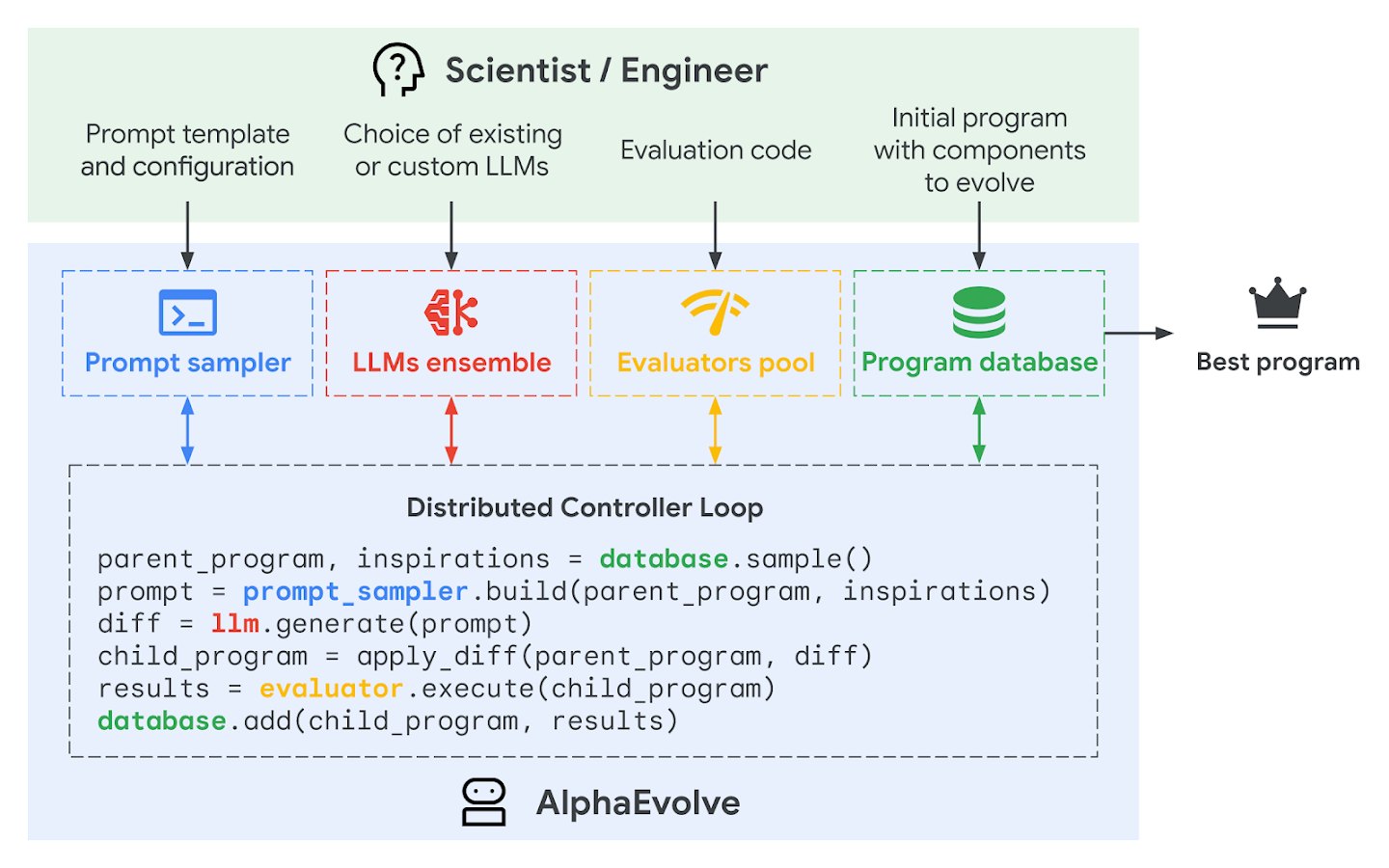
That loop has already been inside Google's own hardware. AlphaEvolve proposed a rewrite, in Verilog, the language chip designers use to describe circuits, that removed unnecessary bits from a key arithmetic circuit for matrix multiplication, the operation at the heart of AI. After checks that the modified circuit still did exactly what it should, the change was built into an upcoming Tensor Processing Unit, Google's own AI accelerator. An AI helped design part of a chip that runs AI.
It has also been quietly running Google's data centers. AlphaEvolve found a heuristic, a rule of thumb, for Borg, the system that decides which of Google's machines runs which job. DeepMind said in May 2025 that it had been in production for more than a year and recovers, on average, 0.7% of Google's worldwide computing resources. That sounds small until you remember what it is a percentage of: the same work, done on less hardware, all the time.
It has sped up the software that trains AI models as well. AlphaEvolve made the FlashAttention kernel, a heavily tuned piece of code inside Transformer models, up to 32.5% faster, in the kind of low-level GPU code that engineers normally leave to compilers. When Google opened it to everyone this summer it listed two more results: refined compaction rules in Google's Spanner database that cut write amplification by 20%, and new compiler strategies that shrank software storage footprints by nearly 9%.
| Where | What it changed | Result Google reports |
|---|---|---|
| A Google TPU | Rewrote an arithmetic circuit for matrix multiplication, in Verilog | Built into an upcoming TPU |
| Borg, Google's cluster scheduler | A new scheduling heuristic | 0.7% of worldwide compute recovered, on average |
| FlashAttention kernel | Low-level GPU code for Transformer models | Up to 32.5% faster |
| Google Spanner database | Compaction heuristics | 20% less write amplification |
| Software storage | Compiler optimisation strategies | Nearly 9% smaller footprint |
Write amplification is worth a sentence, because it affects every SSD. Databases like Spanner don't write your data just once. They keep reorganising their files in the background, and every reorganisation writes the same data again. Write amplification is the ratio of what actually gets written to disk to what you asked to store. Cutting it by a fifth means less disk traffic and less wear on the drives, across a very large number of drives.
Other companies are trying it now. During its preview, Google says, it was tested in logistics, semiconductors, genomics, high performance computing and financial services, and the chipmaker Infineon says its first experiments suggest it could transform how chips are designed. Pushmeet Kohli, Google DeepMind's vice president of science, describes the shift as AI becoming "a discovery engine that expands what we can achieve".
Your headphones may be doing something similar on a much smaller scale. Sony's WH-1000XM6 use what Sony calls an AI-based beamforming system, with six microphones, to pick out the wearer's voice from background noise on calls. Beamforming is the trick of combining several microphones: a sound reaches each one at a slightly different moment depending on where it comes from, and by lining up those timings the headphones can favour sound from the direction of your mouth and play down the rest. Sony's own description puts an AI model in that system. The noise cancelling runs on a dedicated processor, the QN3, which Sony says is seven times faster than the previous model's and handles twelve microphones.
Game studios use it to play their games for them. A modern shooter has an enormous amount to test: researchers at EA's SEED group estimated that Battlefield V has 601 features that need testing, adding up to around half a million hours, some 300 years of work, if it were all done by hand. So SEED has been building test bots with reinforcement learning, where an agent learns by trial and reward instead of following a script, and imitation learning, where it learns from how people play. One of its papers shows how much the plumbing matters too: a better path-following method for AI-driven test vehicles in Battlefield 2042 cut the average time to drive a route by 39% and left them stuck far less often.
There may even be one on your graphics card. NVIDIA's Project G-Assist is an experimental assistant that tunes an RTX PC from typed or spoken requests. It can chart frame rates, latency and temperatures, adjust GPU settings, even change keyboard lighting. It runs a Llama-based model with 8 billion parameters on the graphics card itself, so it is free and works offline, and an update last year cut its memory needs by 40%, bringing it to any RTX card with 6GB or more, laptops included. The AI's job here is translation, from plain English to the right setting.
What these have in common is a clear score. A circuit is smaller or it isn't, a scheduler wastes less compute or it doesn't, a test bot finishes the route or gets stuck. AlphaEvolve is built around exactly that: its evaluators have to be able to measure every proposal automatically. That is the quiet lesson of quiet AI. It does its best work where success can be measured by a machine, and those turn out to be places nobody thinks to look.