
A new class of computer arrived over the past eighteen months, and it is defined by a component that used to be an afterthought. The mini AI workstation is a machine small enough for a desk whose processor and graphics share one pool of memory, sized so that a large language model fits inside it. NVIDIA sells one the size of a hardback book. Apple sells one that takes 512GB. AMD's version turns up in a 4.1-litre box from Framework. What they have in common is that the interesting number on the spec sheet is no longer the core count or even the TOPS rating. It is the memory bandwidth, and almost nobody advertises it.
There is a reason for that, and it is not flattering. Bandwidth is where these machines are weakest, and it is the number that most directly predicts how fast they will actually feel.
Start with the arithmetic, because it is unusually simple. Generating text from a language model is sequential: to produce one token the machine must read the model's weights out of memory, and it must do that again for the next token. At a batch size of one it performs only about one to two floating-point operations for every byte it moves, which is a couple of hundred times below the point where compute becomes the constraint. The consequence is a ceiling you can calculate on a napkin — tokens per second is roughly memory bandwidth divided by the bytes touched per token. Double the bandwidth and you roughly double the speed. Double the compute and, for this phase, very little happens.
That ceiling is why the same machine can post two wildly different numbers on the same model. Reading the prompt is a parallel problem that saturates the arithmetic units; writing the reply is a serial crawl through memory.
The distinction matters commercially because vendors quote the first number. NVIDIA's DGX Spark is rated at up to 1 petaFLOP of FP4 — a figure that includes sparsity, and which describes the prompt-processing bar above, not the generation bar. AMD's Ryzen AI Max+ silicon carries a 50 TOPS NPU rating at INT8. Intel's Panther Lake claims up to 180 platform TOPS, of which 120 comes from the GPU and 50 from the NPU. Qualcomm's Snapdragon X2 Elite quotes 80 TOPS. Those four numbers are at three different numeric precisions, from three different blocks of silicon, and at least one is a sparse figure. Ranking them against each other would be arithmetic theatre. Bandwidth, whatever else it lacks, is one unit measured the same way by everyone.
Ranked that way, the category splits cleanly in two, and the split is roughly four to one.
Apple occupies the top band by itself. The Mac Studio announced on 25 August 2026 and shipping from 22 September pairs the new M5 Ultra — up to a 36-core CPU and an 80-core GPU — with up to 512GB of unified memory at 1.2TB/s, from $5,499. Apple puts its peak AI compute at 4.3 times the M3 Ultra it replaces. The M5 Max version starts at $2,499 with up to 128GB at 614GB/s. The outgoing M3 Ultra, at 819GB/s, still comfortably outruns everything that is not Apple. This is not because Apple built an AI accelerator; it is because a wide memory bus designed years ago for video work happens to be exactly what token generation wants.
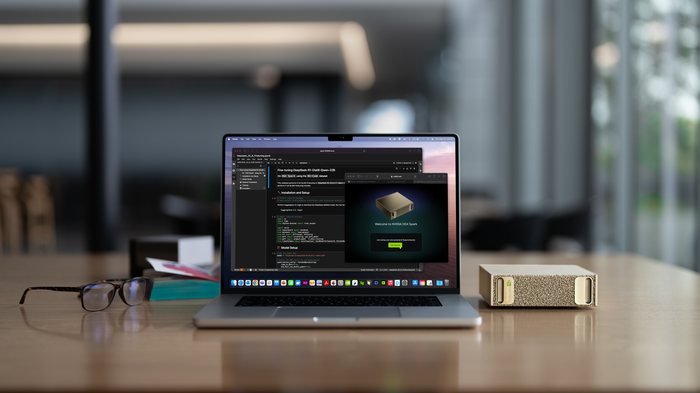
The compact x86 and Arm machines occupy the second band, and they are packed remarkably tightly. NVIDIA's DGX Spark runs a GB10 Grace Blackwell superchip — a 20-core Arm CPU of ten Cortex-X925 and ten Cortex-A725 cores — with 128GB of LPDDR5X on a 256-bit bus at 273GB/s, in a 150mm square case 50.5mm tall that weighs 1.2kg and draws 240W. NVIDIA's Jetson AGX Thor T5000 module hits the same 273GB/s with the same 128GB, rated at 2,070 FP4 TOPS in a 40-130W envelope. AMD's Ryzen AI Max+ 395, the chip everyone calls Strix Halo, runs 128GB of LPDDR5X-8000 across an identical 256-bit bus for 256GB/s. Qualcomm's Snapdragon X2 Elite reaches 228GB/s, though only in laptops — Qualcomm has confirmed there is no desktop part.
Within touching distance of each other, in other words, and all four roughly a quarter of the M5 Ultra. For anyone choosing on token generation speed alone, that is close to the whole story.
Here is the whole field, ranked. Each vendor's compute claim is left in the units it was published in rather than converted into one score, because converting them would hide the problem: an INT8 rating from a neural block, a sparse FP4 peak from a GPU, and a platform total that adds the two together are three different claims wearing the same word. The bandwidth column is the one that can be compared straight down the page.
| # | Machine | Chip | Max memory | Bandwidth | AI compute, as quoted | Price |
|---|---|---|---|---|---|---|
| 1 | NVIDIA DGX Station | GB300 Blackwell Ultra | 748 GB | 7.1 TB/s + 396 GB/s | 20 PFLOPS FP4 | ~$95,000 |
| 2 | Mac Studio (M5 Ultra) | Apple M5 Ultra | 512 GB | 1.2 TB/s | 4.3x M3 Ultra (Apple's figure) | from $5,499 |
| 3 | Mac Studio (M3 Ultra) | Apple M3 Ultra | 512 GB | 819 GB/s | not published as TOPS | outgoing |
| 4 | Mac Studio (M5 Max) | Apple M5 Max | 128 GB | 614 GB/s | 3.9x M4 Max (Apple's figure) | from $2,499 |
| 5 | Framework Desktop 192GB | Ryzen AI Max+ PRO 495 | 192 GB | 273 GB/s (derived) | 50 TOPS INT8 (NPU) | not announced |
| 6 | NVIDIA DGX Spark | GB10 Grace Blackwell | 128 GB | 273 GB/s | 1 PFLOP FP4, sparse | $4,699 |
| 7 | NVIDIA Jetson AGX Thor | Jetson T5000 | 128 GB | 273 GB/s | 2,070 TOPS FP4 | $3,499 dev kit |
| 8 | Framework / HP Z2 / GMKtec | Ryzen AI Max+ 395 | 128 GB | 256 GB/s | 50 TOPS INT8 (NPU) | $3,299-3,499 |
| 9 | Snapdragon X2 Elite laptops | Qualcomm Oryon, 18-core | laptop configs | 228 GB/s | 80 TOPS (Hexagon NPU) | no desktop part |
| 10 | Core Ultra 300 mini PCs | Intel Panther Lake | 128 GB DDR5 | LPDDR5X-9600 class | 180 TOPS platform, 50 NPU | varies by OEM |
Which makes AMD's position more interesting than its bandwidth suggests. The refresh announced at CES 2026 as the Ryzen AI Max 400 series — Gorgon Halo — is not a new architecture. It keeps Zen 5 cores, RDNA 3.5 graphics and the XDNA 2 NPU, and the flagship Ryzen AI Max+ PRO 495 adds 16 cores at up to 5.2GHz with a Radeon 8065S of 40 compute units at 3GHz. What changed is capacity: up to 192GB of unified memory at LPDDR5X-8533, a 50% increase over Strix Halo. Framework has already announced the first mini-ITX desktop built on it, a 4.1-litre machine, though it has not yet published a price or a ship date. AMD has not stated the bandwidth; if the bus is still 256 bits wide, 8533 MT/s gives 273GB/s, which would put it level with DGX Spark. Treat that as arithmetic, not as a specification.
192GB matters more than the modest bandwidth gain, because capacity is a different constraint from speed and it is binary. A model either fits or it does not. Below the line you are choosing between quantisation levels; above it you are not running the model at all.
That is the honest way to read NVIDIA's DGX Station, too, which is the ceiling of this category and arguably outside it — a 1,600W tower listed by OEM partners at around $95,000. Its headline is 748GB of coherent memory and up to 20 petaFLOPS of FP4, and both are true. But the 748GB is two tiers: 252GB of HBM3e running at 7.1TB/s attached to a Blackwell Ultra GPU, plus 496GB of LPDDR5X at 396GB/s attached to a 72-core Grace CPU, bridged by a 900GB/s NVLink-C2C link. Coherent means the GPU can address all of it without you managing the copies. It does not mean all of it runs at 7.1TB/s. A workload that fits in 252GB is on a different machine from one that needs 700GB, and the spec sheet reports one number for both.
Real measurements bear the theory out and add a wrinkle. On gpt-oss-120b in MXFP4, llama.cpp on a DGX Spark records 1,956 tokens per second reading a 2,048-token prompt and 60.57 tokens per second generating — and generation degrades a further 30-40% once context reaches 32k, because the attention cache being walked grows with it. ServeTheHome measured roughly 45 tokens per second on the same model on Ryzen AI Max+ hardware. That ordering matches the bandwidth ordering, which is the point. It is also why cross-machine token counts should be read as directional rather than as a controlled comparison: independent testers use different quantisations, context lengths and backends, and any of the three moves the number more than the hardware gap does.
Then there is the thing nobody planned for, which is that memory has become the expensive part.
DRAM pricing has gone vertical through 2026. TrendForce put LPDDR5X contract prices up around 90% quarter-on-quarter in Q1 and a further 78-83% in Q2, the steepest increases on record, as Samsung, SK Hynix and Micron redirected roughly 70% of high-end output to AI server customers. A mainstream 32GB DDR5-6000 kit that cost $110-140 in Q3 2025 was $392 by mid-2026. The effect on this category is direct and visible, because these machines are mostly memory. DGX Spark launched at $3,999 and now sells for $4,699. The Jetson AGX Thor developer kit was announced at $3,499 and was listed at $5,499 by August 2026. Framework's 128GB Desktop was around $2,459 in January and is $3,449 now. None of these products got faster.
IDC expects global PC shipments to fall 11.3% in 2026 on memory shortages while the market's total value rises to $274 billion — fewer machines, each costing more. The same analysts have AI-capable PCs going from roughly 50 million units in 2024 to more than 167 million in 2027, about 60% of all shipments, with Gartner forecasting that effectively all commercial PC purchases will be AI PCs by the end of this year. The category is growing into a supply squeeze that its own success caused.
So what should someone actually buy? If the work is generating text from large models and the budget reaches it, the bandwidth ranking is not subtle: Apple's M5 Ultra is four times the compact machines and nothing else is close. If the work is CUDA — training, fine-tuning, or anything with a dependency chain that assumes NVIDIA — DGX Spark buys the software stack and the prompt-processing throughput, and its 273GB/s is a known ceiling rather than a surprise. If the constraint is fitting a large model in memory at the lowest price per gigabyte, Strix Halo systems are the value in the category today and Gorgon Halo's 192GB will extend that, whenever it is priced.
And if none of it is urgent, the most defensible answer is to wait, for an unusual reason. The hardware roadmap is not the thing moving fastest. AMD's genuine next generation, Medusa Halo on Zen 6 with LPDDR6, is not expected until 2027-28 and is the first thing on the horizon that would meaningfully move the bandwidth number for the compact class. Between now and then the specifications will barely change, and the prices will.