
NAND Spot Prices Slide 20% in Weeks as Consumer Demand Dries Up
NAND flash appears to be finally getting cheaper, at least on the spot market.
Why am I seeing this Ranked on source trust — TechPowerUp
It ranks mainly on source trust: TechPowerUp is the most reliable outlet we track on this subject, and is the only one on the story so far.
Single-sourced. No second organisation has confirmed it yet.
Link-outLink-out, because only one organisation carries it and no first-party source is on it and the subject could not be identified from the text. Link-out means we point at the publisher and say nothing of our own.
| Factor | Weight | Score | Contribution | Where it came from |
|---|---|---|---|---|
| Corroboration | 0.35 | 0.39 | +0.135 26% | 1 independent org on the story. Tier-3 aggregators never corroborate — they can show something is circulating, never that it is true. |
| Source trustleads | 0.25 | 0.80 | +0.200 39% | TechPowerUp is the highest-trust source on this story. Trust is taken from the best source, not averaged. |
| Pickup rate | 0.20 | 0.00 | +0.000 0% | One counted organisation, so there is no spread to measure — nothing has picked this up to set a rate. |
| Freshness | 0.20 | 0.91 | +0.182 35% | Halves every 10 hours from the newest item on the story. This is the only factor that rewards a story for nothing more than being recent. |
Corroboration counts distinct organisations, once each, and only from tiers 1 and 2. Freshness halves every 10 hours, so this ranking is a snapshot and will differ at the next build.
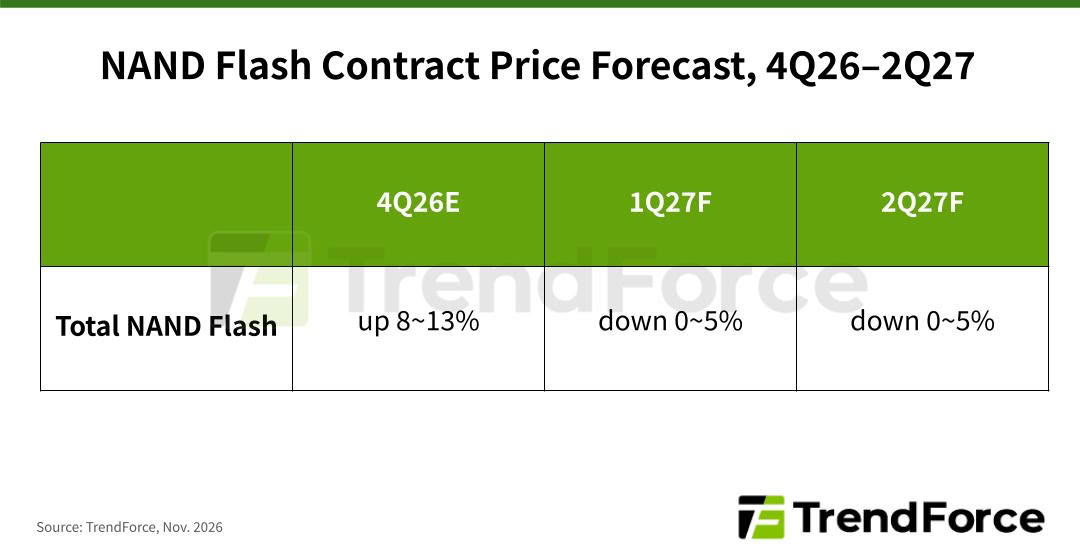
Spot prices for NAND flash memory have fallen roughly 20% since mid-October, with the decline occurring over two weeks as Chinese traders cleared inventory. A 512 gigabit wafer now costs about $14.30, representing a 32% drop from the previous quarter, while 1 terabit products fell 19% to $24.90. The price decline stems from weak consumer demand, as buyers postpone upgrades due to high costs and manufacturers reduce storage specifications or sell existing stock.
Contract prices, which operate on longer-term agreements, have responded more slowly than spot prices. Bank of America projects smartphone and PC NAND contract prices will decline 5-10% quarter-over-quarter in the first quarter of 2027, while enterprise products are expected to remain flat or increase slightly. TrendForce forecasts overall NAND contract prices will shift between 0-5% in the second quarter of 2027.
The price reductions mark a shift from earlier predictions that anticipated continued shortages for at least three additional years. Consumer-side SSD prices are expected to continue declining gradually through 2027, though the pace of decrease will be slower than recent spot market movements.
What happened
NAND flash appears to be finally getting cheaper, at least on the spot market. According to the Seoul Economic Daily, spot prices for NAND flash have dropped roughly 20% since the second half of October. TrendForce says the drop in price took just two weeks, as Chinese traders dumped inventory. A 512 Gb wafer now goes for about $14.30, which is 32% below last quarter, and 1 Tb products are down 19% to $24.90. Apparently, the reasoning is weak consumer demand, since buyers are now delaying upgrades due to high prices. Moreover, phone manufacturers are trimming base storage specs, and PC makers are selling through their existing stock as shipments continue to fall.
How this story arrived
Ordered by when each source was first observed, which is what the velocity figure is computed from. Publishers backdate; observed order does not.
- 01 Techpowerup first seen NAND Spot Prices Slide 20% in Weeks as Consumer Demand Dries Up
Overclock clusters coverage from independent sources and grades it automatically. The figures above are computed, not editorial. This page summarises and links to reporting by the outlets named — follow the links for the original work.