
Every earlier version of DLSS has been, at heart, a very clever approximation. The game renders less than your screen needs, fewer pixels or fewer frames, and a neural network fills in what a more expensive render would have looked like. DLSS 5 changes the job. On 1 September NVIDIA's Applied Deep Learning Research group published a page setting out how it works, and its central claim is that DLSS 5 is "the first DLSS technology to generate the final displayed appearance", rather than reconstruct it.
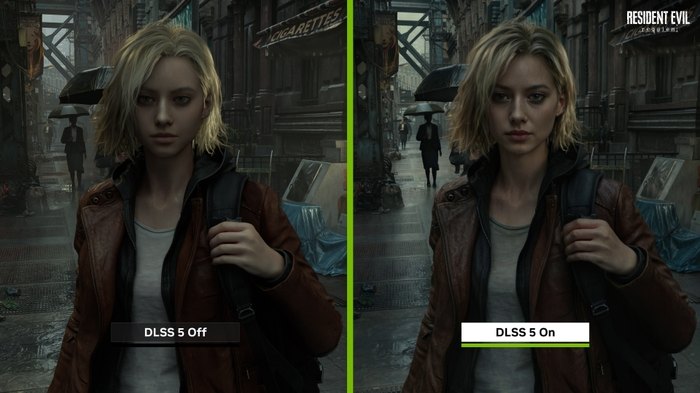
Generate it from what? From the game's own frame, plus what the model has learned about how the real world looks. NVIDIA calls these learned appearance priors: knowledge picked up from real-world visual data about how light and materials behave, which no amount of extra rendering samples can efficiently supply. The game still decides what is in the scene and where it is. DLSS 5 changes how it looks, and NVIDIA's page stresses that it complements the game's renderer and its artists rather than replacing them.
The model is a diffusion model, from the same family as the image generators that turn text into pictures. Those usually start from random noise and remove it a little at a time, over many steps, each one a full pass through a large network. That is fine when you are happy to wait a few seconds for a picture and hopeless when a game running at 60 frames per second has under 17 milliseconds for everything. NVIDIA's version runs in a single step. It works directly on pixels, where many image generators work in a compressed intermediate form, and it is not working blind: for every frame it is given the rendered image, the engine's motion vectors, state carried over from previous frames, and the values the game's artists have set.
Two more words on that page do a lot of work: causal and deterministic. Causal means each frame is made only from the present and the past, never from frames that haven't happened yet, which a live game could not provide anyway. Deterministic means the same inputs always give the same output. An ordinary image generator adds randomness on purpose, which is why the same prompt gives a different picture every time; in a game that randomness would show up as shimmer from one frame to the next. NVIDIA says the model is also trained specifically for frame-to-frame stability, and runs inside a strict compute budget for every frame, at up to 4K.
What NVIDIA spent SIGGRAPH on was control. At its keynote in Los Angeles on 20 July, NVIDIA listed three challenges for DLSS 5: preserving artistic intent, frame-by-frame streaming and real-time 4K, according to PCGuide, which reported the slides. Developers get three trained models, Model A, Model B and Model C, which interpret a scene differently and can be mixed across a game by scene, environment, object or character. Club386, which also covered the session, reports NVIDIA's reasoning: there is no single correct reference image for these scenes, so more than one result can make sense, and the developer has to choose.
On top of the models come two global sliders running from 0 to 1, Structure Intensity and Tone Intensity, which Club386 describes as setting how strongly DLSS 5 works across the complex and simple parts of a scene. There is also developer masking, with automatic detection of models and characters, so an artist can leave the effect off a particular character or object. Characters were the obvious concern: Grace Ashcroft from Resident Evil Requiem was a leading example in NVIDIA's March demonstration, and PCGuide notes that with masking a studio could simply leave its character models out.
| Control | What it does |
|---|---|
| Model A, B or C | Three trained models that interpret a scene differently; mix them by scene, environment, object or character |
| Structure Intensity | A global slider from 0 to 1 |
| Tone Intensity | A global slider from 0 to 1 |
| Developer masking | Turn the effect on or off for individual objects or characters, with automatic detection of models and characters |
NVIDIA's research page says DLSS 5 runs on GeForce RTX 50 Series GPUs. NVIDIA said in March that it would arrive this fall, with support from publishers including Bethesda, CAPCOM, Tencent, Ubisoft and Warner Bros. Games, and in games including Starfield, Resident Evil Requiem, Assassin's Creed Shadows and Hogwarts Legacy. Studios plug it in through Streamline, the same framework they already use for DLSS and NVIDIA Reflex.
What has not been published is the cost. PCGuide reports that the March preview needed two RTX 5090s and that NVIDIA is optimising DLSS 5 to run on one GPU, but neither NVIDIA's research page nor the SIGGRAPH coverage gives a frame-time or memory cost, and we could find no independent measurement. That is the number to watch when it ships. Until then the fair summary is NVIDIA's own: a generative stage inside the rendering pipeline, working alongside the game's renderer, and a genuinely new kind of DLSS.