
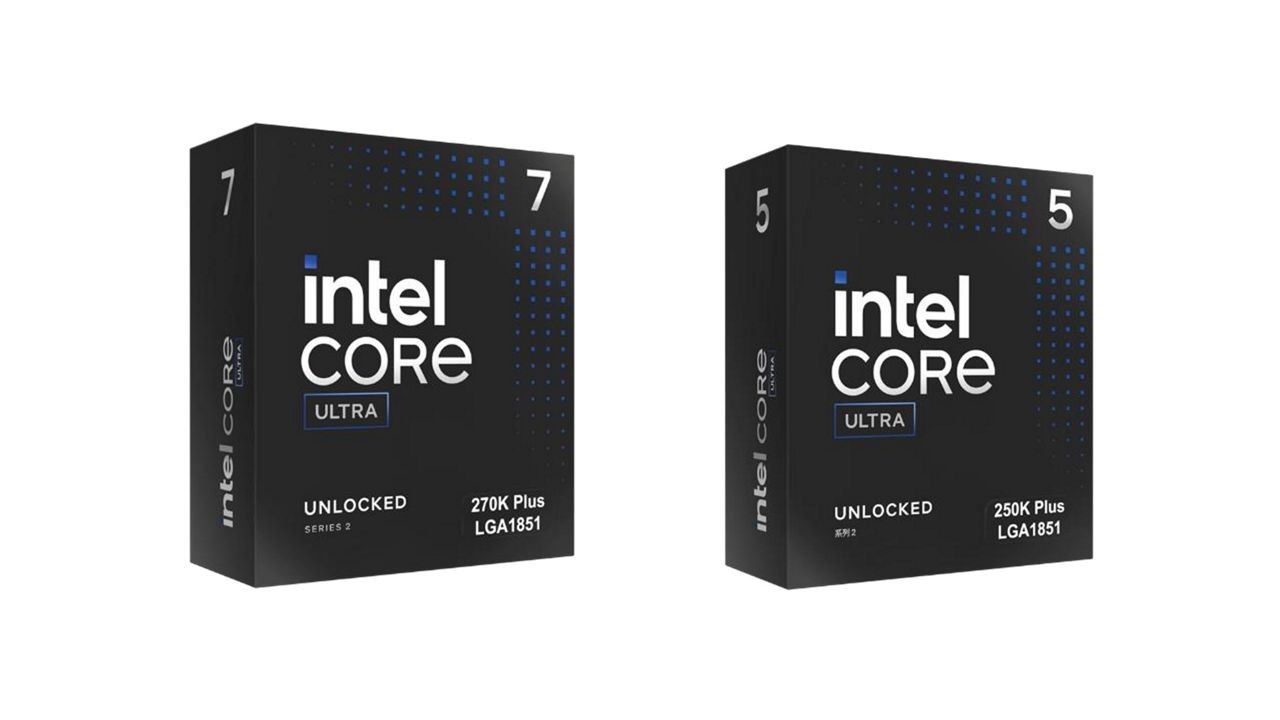
For as long as people have built gaming PCs there has been a rule about memory: you can have a lot of it or you can have it fast, and the more you fit, the slower it tends to run. This year a small chip on the memory stick is bending that rule. In March Intel launched its Core Ultra 200S Plus desktop processors, the $299 Core Ultra 7 270K Plus and the $199 Core Ultra 5 250K Plus, with early support for what it calls 4-rank CUDIMM memory, which can hold up to 128GB on a single module. Two of them make 256GB, in just two slots.
To see why that is hard, it helps to know what a rank is. A memory module carries a row of DRAM chips, and a rank is one set of those chips that the processor reads and writes together as a single block. More ranks means more chips, and more chips means more capacity. It also means more electrical load on the wires between the processor and the module. One of the signals that suffers is the clock, the timing beat every chip on the module listens to. The more chips it has to reach, the more its edges blur, and a blurred clock forces the memory to run slower.
A CUDIMM, short for clocked unbuffered DIMM, deals with that by adding one chip: a clock driver on the module itself. The processor sends its clock to the clock driver, and the clock driver sends a fresh copy on to the memory chips, so the processor only has to drive one clean load instead of many. The data still travels straight between the processor and the memory chips, which is what unbuffered means; only the clock gets the help. When Micron began shipping CUDIMMs in volume in October 2024, it said they ran at up to 6,400 MT/s at standard JEDEC settings, 15% faster than DDR5 without a clock driver.
Four-rank modules point the same idea at capacity. A 4-rank module has twice the ranks of a typical dual-rank stick, and all the load that comes with them, and the clock driver is what is meant to keep it quick anyway. Intel's figure is up to 128GB per module. It is also careful to call this an emerging technology, supported on selected motherboards with its 800-series chipsets and arriving through 2026.
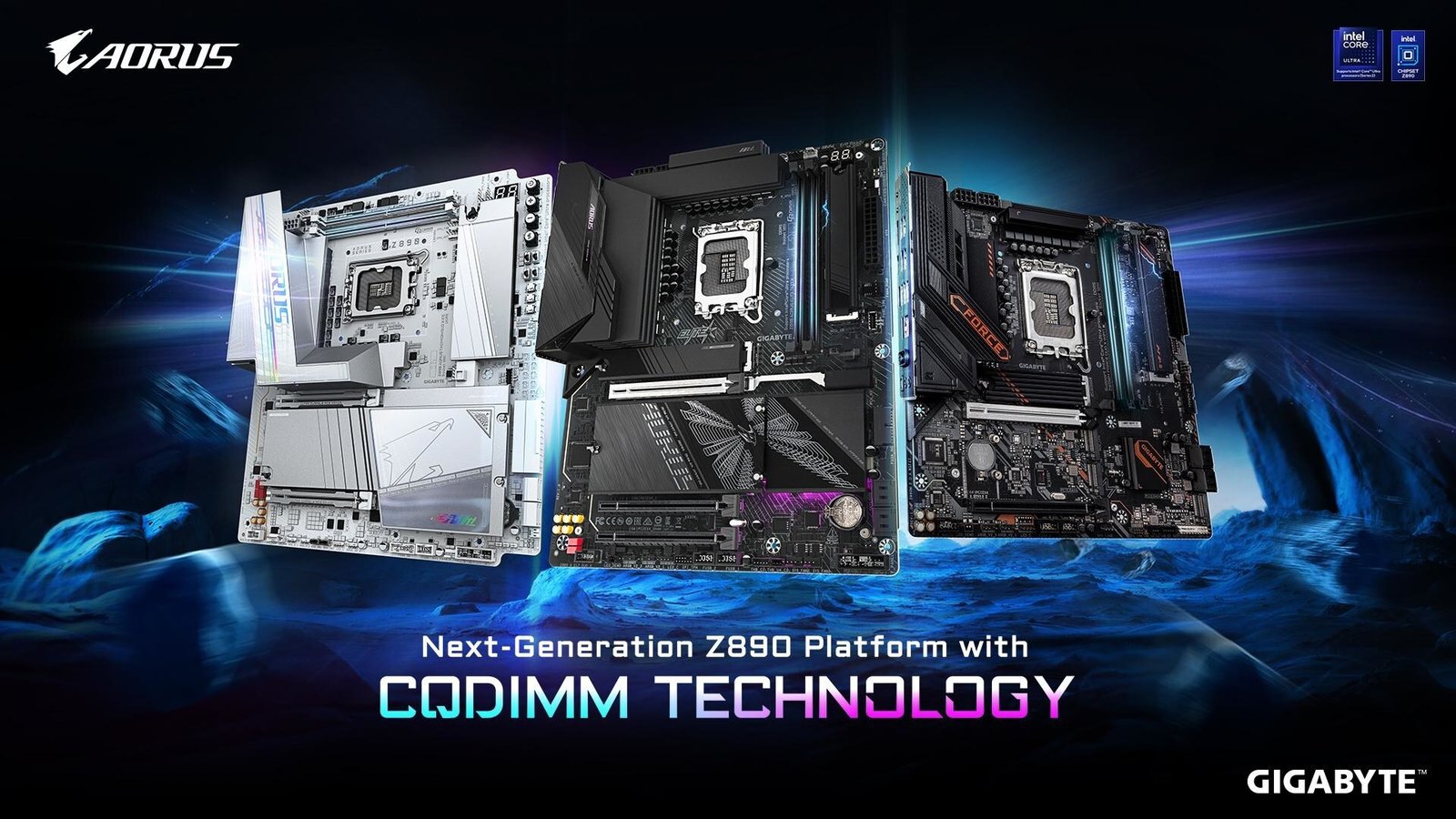
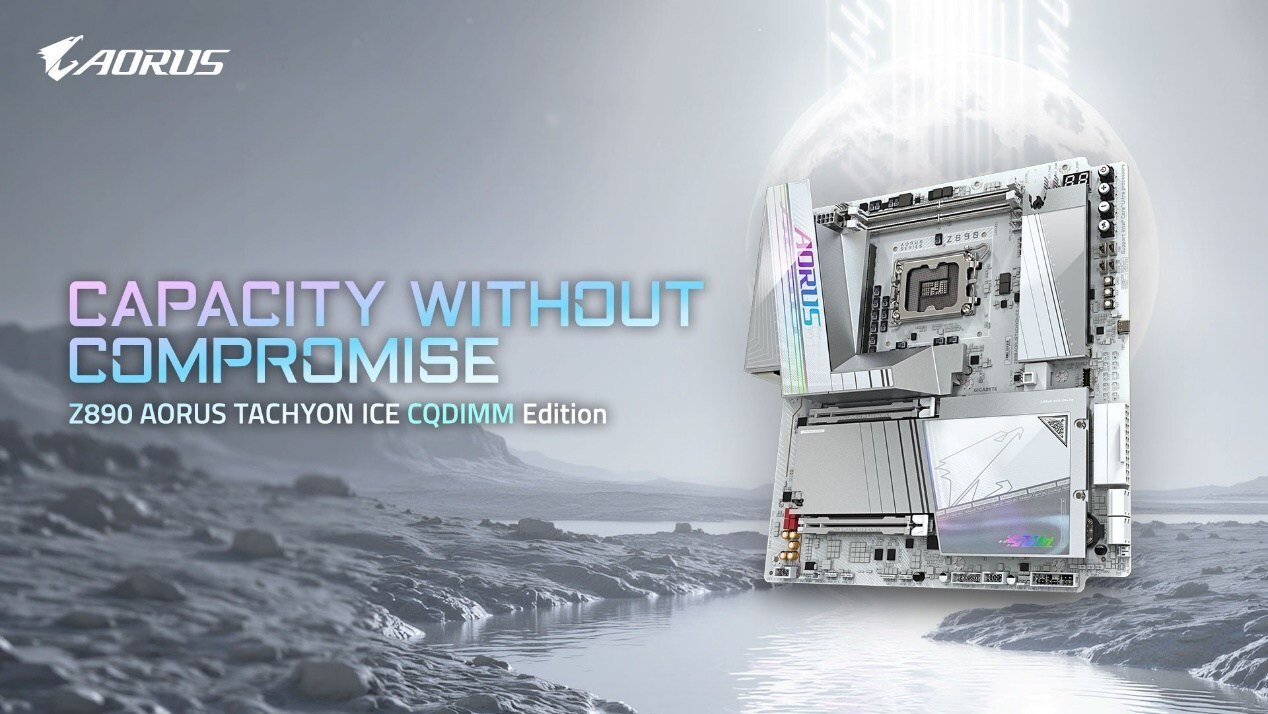
GIGABYTE has been the loudest about it. At CES in January it ran two 128GB modules at DDR5-7200 on a Z890 AORUS Tachyon ICE CQDIMM Edition board, which it called an industry first. CQDIMM is GIGABYTE's own name, and its release spells it out as a clocked unbuffered DIMM, the same thing the industry calls a CUDIMM. GIGABYTE says the rest of the gain comes from the motherboard: a circuit layout that reduces the load on each memory channel, and BIOS tuning of timing, signal synchronisation and voltage.
In March it put boards on sale built around the idea, the Z890 AORUS ELITE DUO X and Z890M FORCE DUO X WIFI7, each designed for the full 256GB in two 128GB modules. By Computex in June it was quoting speeds of up to 10,400 MT/s for the family, although that is an overclocking figure and the release does not say it holds at full capacity. It named seven memory makers it is working with: BIWIN, Corsair, G.Skill, Kingston, TeamGroup, V-Color and XPG.
| What | Capacity | Speed | Who says, when |
|---|---|---|---|
| Crucial DDR5 CUDIMM at standard JEDEC settings | Not the point | Up to 6,400 MT/s, 15% faster than DDR5 without a clock driver | Micron, Oct 2024 |
| Intel Core Ultra 200S Plus with 4-rank CUDIMM | Up to 128GB per module | Not stated | Intel, Mar 2026 |
| Two 128GB modules, Z890 AORUS Tachyon ICE CQDIMM Edition | 256GB | 7,200 MT/s | GIGABYTE, Jan 2026 |
| Z890 Plus DUO X boards | 256GB in two modules supported | Up to 10,400 MT/s overclocked; not stated at full capacity | GIGABYTE, Jun 2026 |
Who needs 256GB in a desktop? Not most gamers; games come nowhere near it. It is for people who want workstation amounts of memory on a desktop board: running several virtual machines, working on very large projects, or loading big AI models into system memory. Until now that usually meant filling four slots and accepting slower memory, or paying for a workstation platform.
Two cautions. It is early: Intel's own word for 4-rank CUDIMM support is emerging, and only selected boards have it. And 128GB modules are arriving in the middle of a memory price squeeze driven by AI data centers; GIGABYTE's releases name its memory partners but give no module prices. The engineering is the part worth knowing either way. A small chip on the module, doing one job, is what lets 256GB and high speed share two slots.