
Bungie published a five-minute video and a 1,367-word post on Monday under the title "The Next Chapter for Bungie", and the headline in it is one the Destiny community has wanted for six years: the campaigns, destinations and raids removed from Destiny 2 are coming back. Studio head Poria Torkan and head of product Josh Deane, who is also general manager of Marathon, deliver the message from a sofa. "All of this is to say, we are not done with Destiny," the post says. Three months ago the same studio shipped Destiny 2's final content update and then laid off most of the people who made it.
This piece does two separate things, and tries not to blur them. First it reports what Bungie said, from the post and from a timed transcript built out of the video's own English subtitle track. Then it reads the announcement: the staging, the word choices, the things that are missing. Everything in that second half is labelled as inference and carries its reasoning, because a scripted, multi-take, edited corporate video is evidence of what a company chose to present, and not evidence of what anybody in it is feeling.
The four months behind this are worth laying out first, because they are the reason a promise to restore old content counts as news at all.
| When | What happened |
|---|---|
| May 2026 | Bungie says Destiny 2's next update will be its last, about five weeks before the layoffs, per Game Informer |
| 9 June | Monument of Triumph ships as the final content update, alongside Destiny 2: The Collection |
| 25 June | Layoffs hit most of the Destiny team, some Marathon developers and Sony staff supporting Bungie, announced in a statement from Sony's Hermen Hulst. Push Square later put the total at 292 |
| 25 June | Studio head Justin Truman departs, under a year after replacing Pete Parsons. Poria Torkan, then VP of operations, takes over, per Paul Tassi's reporting relayed by Push Square |
| 21 September | "The Next Chapter for Bungie": a 5:05 video and a 1,367-word post commit to unvaulting Destiny 2 campaigns, destinations and raids |
| This week | A Marathon-specific vision update, promised in the post |
| October, December | Marathon's Nightfall Refresh, then the Symbiosis update, which PC Gamer reports brings a permanent PvE mode and a social space |
Now the promise, exactly as made. In the video, at 1:44, it is Deane who says the studio will "commit to unvaulting the Destiny 2 campaigns, the destinations, the raids that never should have been ripped away to begin with." The post is more careful: it describes "restoring important parts of Destiny 2's history", says the work is beginning, and says the content will be "available to all Destiny 2 players". Three qualifiers matter there. Nothing is named. There is no date. And neither text promises all of it: every instance of the word "all" in the video is the phrase "you all", and the post uses it twice for "you all" and once for "all Destiny 2 players". Several outlets went with headlines saying all vaulted content is returning. Bungie's own words say "important parts".
For scale, what went into the Destiny Content Vault with Beyond Light in November 2020 was close to half the game: the original Red War campaign, the Curse of Osiris and Warmind expansions, the Year Two annual pass content, and the Titan, Io, Mars and Mercury destinations, along with the raids attached to them. Bungie said at the time that vaulted locations could return later in reworked form. That is the promise being picked back up.
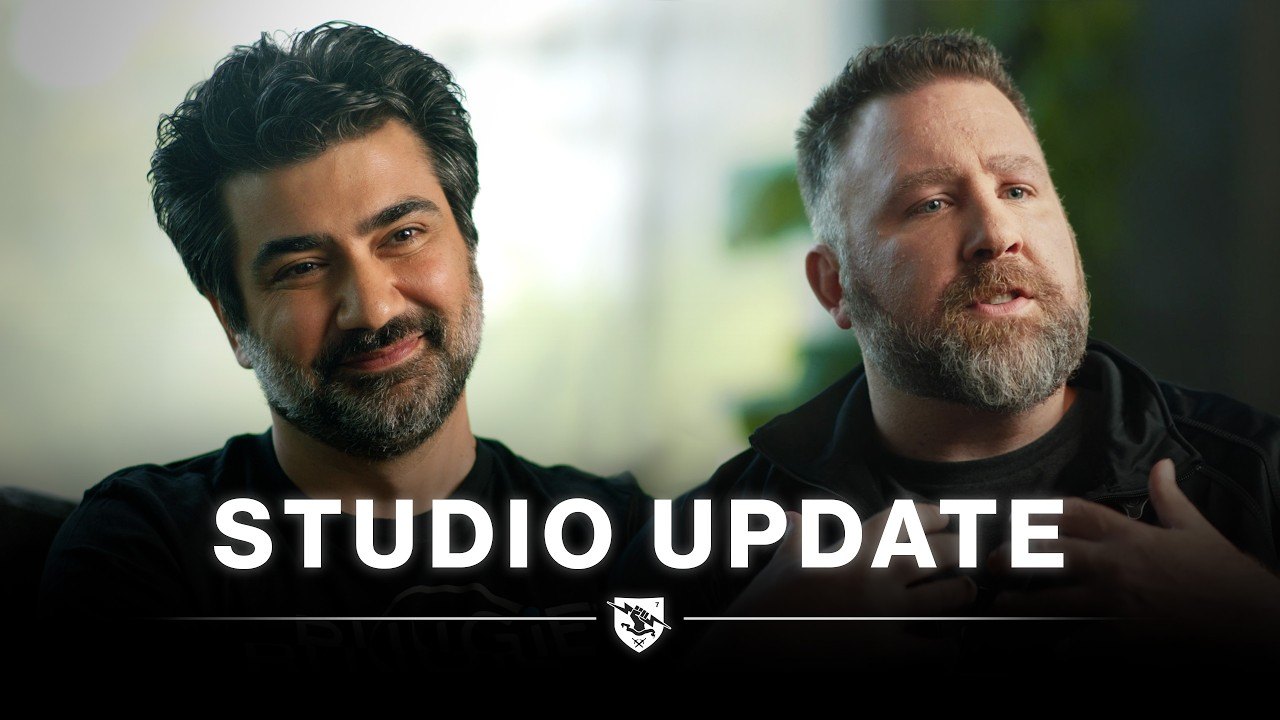
The video is also worth describing as an object, because its form is a decision. It runs 5:05. Two men sit on a grey sofa in a bright room with big windows, city and greenery behind them, both in black Bungie-branded clothing, with lower-third name captions. A scene-change pass over the file finds 36 cuts, and every one of them is the same two-hander: singles, two-shots, singles again. There is no gameplay, no concept art, no logo reveal, no roadmap slide, no date on screen, nothing at all but the two of them talking. Bungie's own thumbnail for it reads STUDIO UPDATE, and neither the thumbnail nor the title contains the word Destiny. About eleven hours after it went up the video had roughly 808,000 views, 61,000 likes and 12,000 comments. One small oddity: the video was published on Monday and the coverage all followed that day, but bungie.net stamps the post itself 17 September, four days earlier. The mundane reading, and it is only a reading, is that the words were finished and staged well before anyone pressed publish.
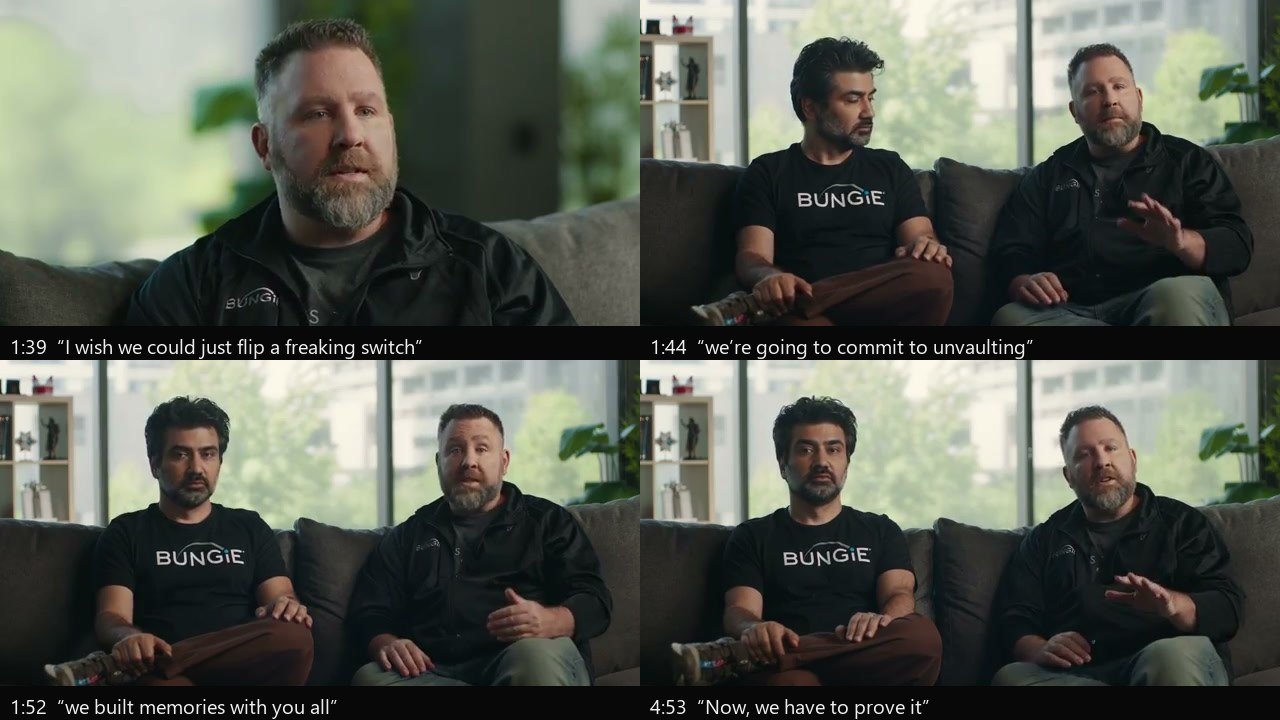
The seating tells you something about who is doing what. Torkan, the studio head, opens the video, owns the failures and sets out the Destiny principles. Deane, the product head, delivers the concrete commitment. Across half-second frame steps from 1:43 to 1:47, Deane is mid-sentence and mid-gesture while Torkan sits silent with his hands flat on his thigh, head turned towards him, eyes dropping to his lap at 1:46 and 1:48. Torkan's posture through the whole piece is the more closed of the two: legs crossed ankle-over-knee, hands low, gestures rarely rising above his waist. Deane gestures constantly with one open palm at chest height, the standard offering gesture.
What that might mean, and this is inference rather than fact: the staging is the grammar of an apology, not of a reveal. Companies sit executives on sofas in daylight without slides when the goal is to be believed rather than to be exciting, and the low gesture amplitude, the informality and the absence of anything on screen all point the same way. The straightest reading of Torkan's downward glances is simple listening while a colleague speaks, and the alternative readings are worth stating: these are edited takes, sitting still is what people do when someone else is talking, and reading discomfort into a glance is exactly the kind of claim that cannot be falsified. The firmer observation is the division of labour itself. The person who put his name to the specific, checkable promise is the head of product, and the studio head is the one who apologises.
The words are more measurable than the postures, and they are unusually consistent. The post says "trust" eight times in 1,367 words, and pairs it every time with the claim that trust has to be earned rather than asked for: "We are not asking you to trust what we say today." The video, at 934 words, is written to be heard rather than read; it says "you" 37 times against 38 uses of "we", where the post is 65 to 23. And in neither text does any form of "sorry" or "apologise" appear, which is notable given how much of the coverage described the announcement as an apology. What Bungie actually does is accept blame in the active voice: we lost trust, that's on us, we must own that. As a piece of writing that is a deliberate choice, because an apology invites you to accept it and an admission invites you to keep watching.
More striking is the list of things the announcement does not say at all.
| Question | The answer in the post and video |
|---|---|
| Which content returns? | "campaigns, destinations, and raids", described as "important parts" of Destiny 2's history. Nothing is named, and neither text says all of it |
| When? | No date of any kind. More detail is promised "in the coming months" |
| What will it cost? | Not addressed. The content is to be "available to all Destiny 2 players" |
| Who builds it? | Not addressed |
| A new Destiny game? | "new stories and games", plural, with no name, scope or date |
| Destiny 3? | The phrase appears nowhere in either text |
| Sony? | Bungie's owner is never mentioned |
| The layoffs? | Referred to once, obliquely: "we lost incredible colleagues" |
| An apology? | No form of "sorry" or "apologise" appears in the 1,367-word post or the 934-word video, though several outlets described it as an apology |
| How will we know it worked? | A report against four commitments, to arrive "alongside our next major updates" |
Which raises the question the announcement never touches: who does the work. On the day Bungie promised to restore Destiny 2, its public job board carried five openings, read at about 22:30 Central on Monday. Three name Marathon. Four of the five are contract roles. None mentions Destiny. That is a snapshot and not a staffing plan, and studios routinely hire without posting publicly. But if a restoration programme of this size were staffing up in the open, it would look different from this. The inference, labelled as such, is that the near-term unvaulting work is being done by a small internal group, contract staff, or an external partner, and that the first real evidence either way will be Destiny engineering roles appearing on that board.
| Role | Game named | Terms |
|---|---|---|
| Investment Designer | None stated | Contract, remote |
| Marathon Producer | Marathon | Contract, remote |
| Marathon UI/UX Director | Marathon | No contract tag, remote |
| Principal Marketing Manager, Marathon | Marathon | Contract, remote |
| Senior Producer, Multimedia | None stated | Contract, remote |
One part of the announcement reads like it came from engineers rather than marketing, and that is the part worth trusting most. The post explains that restoring the content is not a matter of restoring old files, because changes since Beyond Light mean lighting, encounters, combatants and other underlying systems have to be updated so the returning content matches Destiny 2's current standards. That is a specific and unglamorous claim, the kind that is easy to check later and embarrassing to fake, and it is consistent with the absence of a date.
From that, a prediction, offered as speculation with its reasoning. Raids are self-contained instances with fixed encounters and no seasonal plumbing; a destination has patrol spaces, public events, vendors, quest hooks and reward pools wired into systems that have been rebuilt repeatedly since 2020. If the work is ordered by cost, raids come back first and destinations last, whatever order the sentence listed them in. Bungie has said nothing about sequencing, so treat this as an expectation to test rather than a report.
Marathon gets the other half of the announcement, and its language is a bigger shift than it first appears. Bungie says it will keep what makes Marathon distinctive but take it "beyond the genre constraints we placed on it" and expand it into "a deeper survival experience", with more agency over how players engage, whether cooperative, competitive or the mix in between. PC Gamer reports a permanent PvE mode and a social space arriving in the December Symbiosis update, and Bungie has already dropped Marathon's strict seasonal schedule. Read plainly, the extraction shooter is being reshaped towards the things Destiny players liked, at the same moment the studio promises to restore Destiny. Whether that is convergence or hedging is the thing to watch; the post also promises a Marathon-specific vision update later this week, which makes it the first checkable claim in the whole announcement.
The business reading, again as speculation. Unvaulting is the cheapest goodwill available to Bungie right now: the content exists, it was paid for years ago, it carries no new creative risk, and it can be delivered by a small team while larger projects sit in early incubation. It also keeps Destiny 2 alive as the shop window for whatever comes next, which matters if the next Destiny product is years away. In June, Push Square reported that new projects were in early pre-production and that none of them was Destiny 3; Monday's post upgrades that to "new stories and games" with no name attached. The most likely thing Bungie is not telling us is not a secret sequel. It is that nothing else is close enough to show, which is also the simplest explanation for a five-minute video with no footage in it.
So here is the checklist this announcement can be graded against, and none of it requires taking anyone's word: Destiny engineering roles appearing on the job board; the promised accountability report actually arriving, with numbers, alongside the next major updates; the first unvaulted content shipping with a date attached rather than a blog post; the phrase "important parts" resolving into named raids and destinations; and whether the original Destiny content also sitting in that vault ever gets mentioned again.
The last word in the video is the right one to end on. "Now, we have to prove it," Deane says at 4:53, right after saying that trust will not be rebuilt with words. The studio has earned the scepticism it acknowledges; it told players four months ago that Destiny 2 was finished, and the reason it is talking again is that they refused to accept it. What is new here is not a roadmap. It is an admission, a scope it has deliberately left vague, and a promise to be measured in public. All three are worth holding onto.