
AMD Wants to Ray Trace Large, Dynamic Worlds with Reusable Parts
To scale large, open, dynamic worlds with ray tracing, AMD is developing a new approach to simplify the process.
Why am I seeing this Ranked on source trust — TechPowerUp
It ranks mainly on source trust: TechPowerUp is the most reliable outlet we track on this subject, and is the only one on the story so far.
Single-sourced. No second organisation has confirmed it yet.
Link-outLink-out, because only one organisation carries it and no first-party source is on it. Link-out means we point at the publisher and say nothing of our own.
| Factor | Weight | Score | Contribution | Where it came from |
|---|---|---|---|---|
| Corroboration | 0.35 | 0.39 | +0.135 25% | 1 independent org on the story. Tier-3 aggregators never corroborate — they can show something is circulating, never that it is true. |
| Source trustleads | 0.25 | 0.80 | +0.200 38% | TechPowerUp is the highest-trust source on this story. Trust is taken from the best source, not averaged. |
| Pickup rate | 0.20 | 0.00 | +0.000 0% | One counted organisation, so there is no spread to measure — nothing has picked this up to set a rate. |
| Freshness | 0.20 | 0.99 | +0.198 37% | Halves every 10 hours from the newest item on the story. This is the only factor that rewards a story for nothing more than being recent. |
Corroboration counts distinct organisations, once each, and only from tiers 1 and 2. Freshness halves every 10 hours, so this ranking is a snapshot and will differ at the next build.
What happened
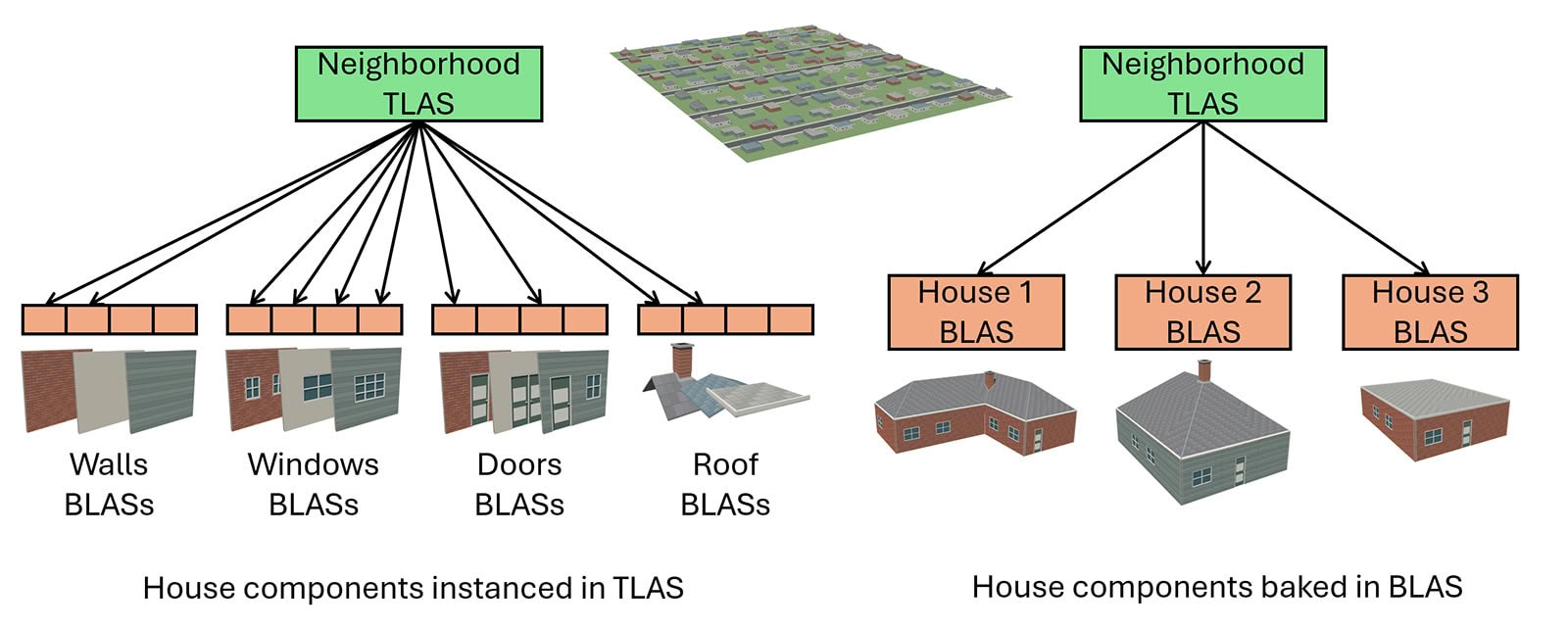
To scale large, open, dynamic worlds with ray tracing, AMD is developing a new approach to simplify the process. By extending traditional techniques, AMD introduces Ray Tracing Multi-Level Acceleration Structures (RT-MLAS). This technology adds additional levels of reusable acceleration structures within ray-traced objects, reducing both memory consumption and the time required to build and update them. Traditional ray tracing pipelines rely on two levels of acceleration structures: Bottom-Level Acceleration Structures (BLAS), which contain geometry, and a Top-Level Acceleration Structure (TLAS), which organizes instances of that geometry.
How this story arrived
Ordered by when each source was first observed, which is what the velocity figure is computed from. Publishers backdate; observed order does not.
- 01 Techpowerup first seen AMD Wants to Ray Trace Large, Dynamic Worlds with Reusable Parts
Overclock clusters coverage from independent sources and grades it automatically. The figures above are computed, not editorial. This page summarises and links to reporting by the outlets named — follow the links for the original work.